The Hot Sauce Heat Planner
Hit the heat you meant: read every pepper as the range it is, add it in measured steps, blend and swap at equal heat, rescue a batch that ran hot, and scale and price it by weight
ChiliHeat's Hot Sauce Heat-Scaling Calculator gives one pepper weight for a target heat, worked from one Scoville number per pepper. Our own Pepper Reference page lists the range each number sits in, and some run five to one from the mildest pod to the hottest. So every calculator on the site gives a single answer to a question whose honest answer is a bracket. This planner turns each answer into that bracket and a way to walk it. In its worked example, 900 g of sauce base, a habanero and a 5,000 SHU target: the calculator says 18.37 g, which lands anywhere from 2,000 to 7,000 SHU because a habanero runs 100,000 to 350,000. The planner starts at 13.04 g (the pod at the top of its range) and climbs in four measured additions to 47.37 g (the bottom), tasting between. Add the 47.37 g all at once with hot pods and the sauce reaches 17,500 SHU, 3.5 times the target, and takes 2,368.61 g of extra base to rescue. It also sets a mild flavor pepper before the hot one, checks every swap for weight as well as heat (four serranos as jalapeños is 280 g of pepper where the recipe had 32 g), and scales and prices a batch per bottle. Every figure is computed from our own calculators; the batch, prices and bottle size are examples, and the Scoville figures are commonly cited ranges, not measurements. It is about heat and weight only: it does not cover making a sauce shelf-stable, fermenting, canning, drying or infused oils, and it says to keep homemade sauce in the refrigerator unless a tested shelf-stable recipe is followed exactly. Inside: 7 steps, 3 printable working pages (a batch plan and additions log, a swap and blend worksheet, a scale and cost sheet), a reference table and a quickstart, plus a personalised sheet worked from the numbers you enter in our heat-scaling, dilution, substitution and blend calculators.
Look inside
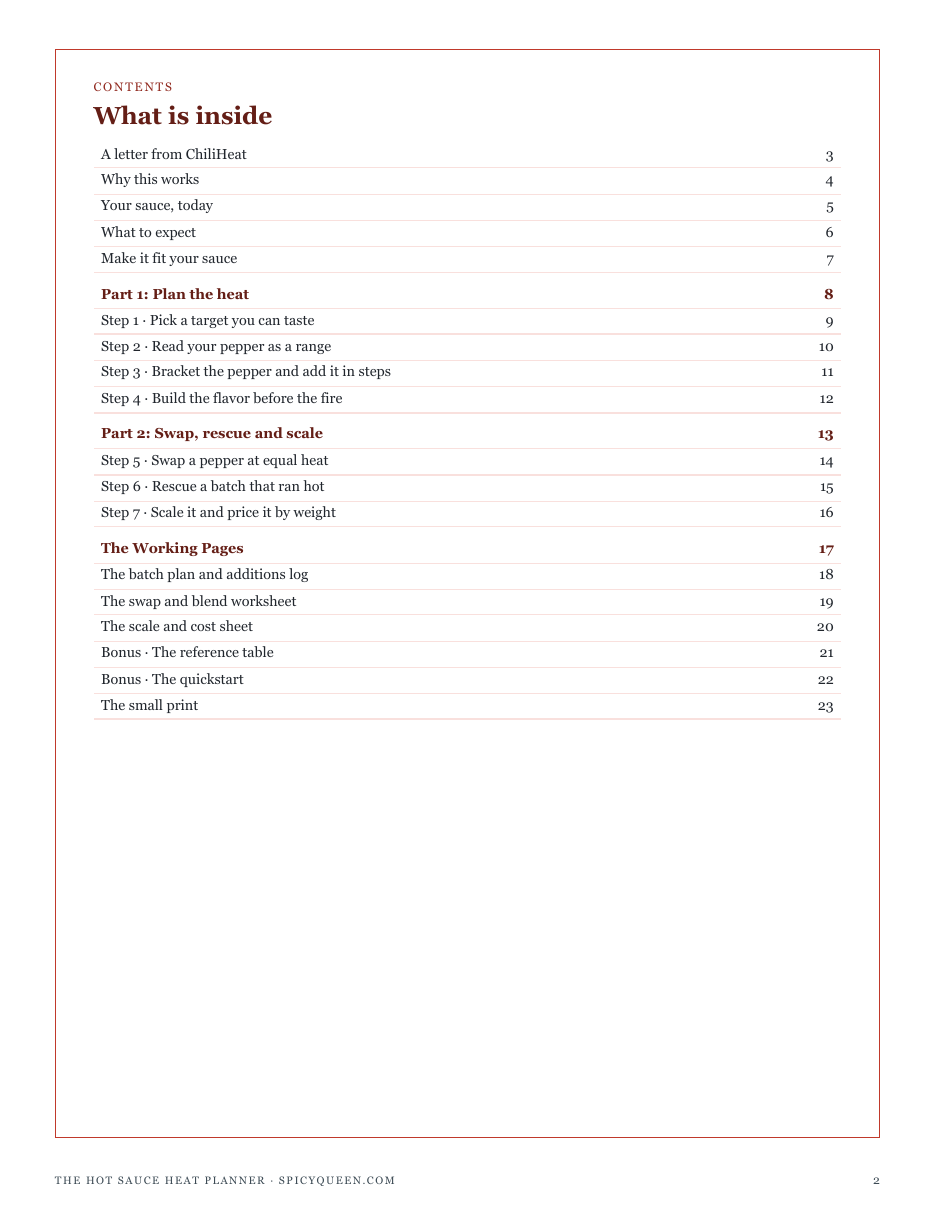
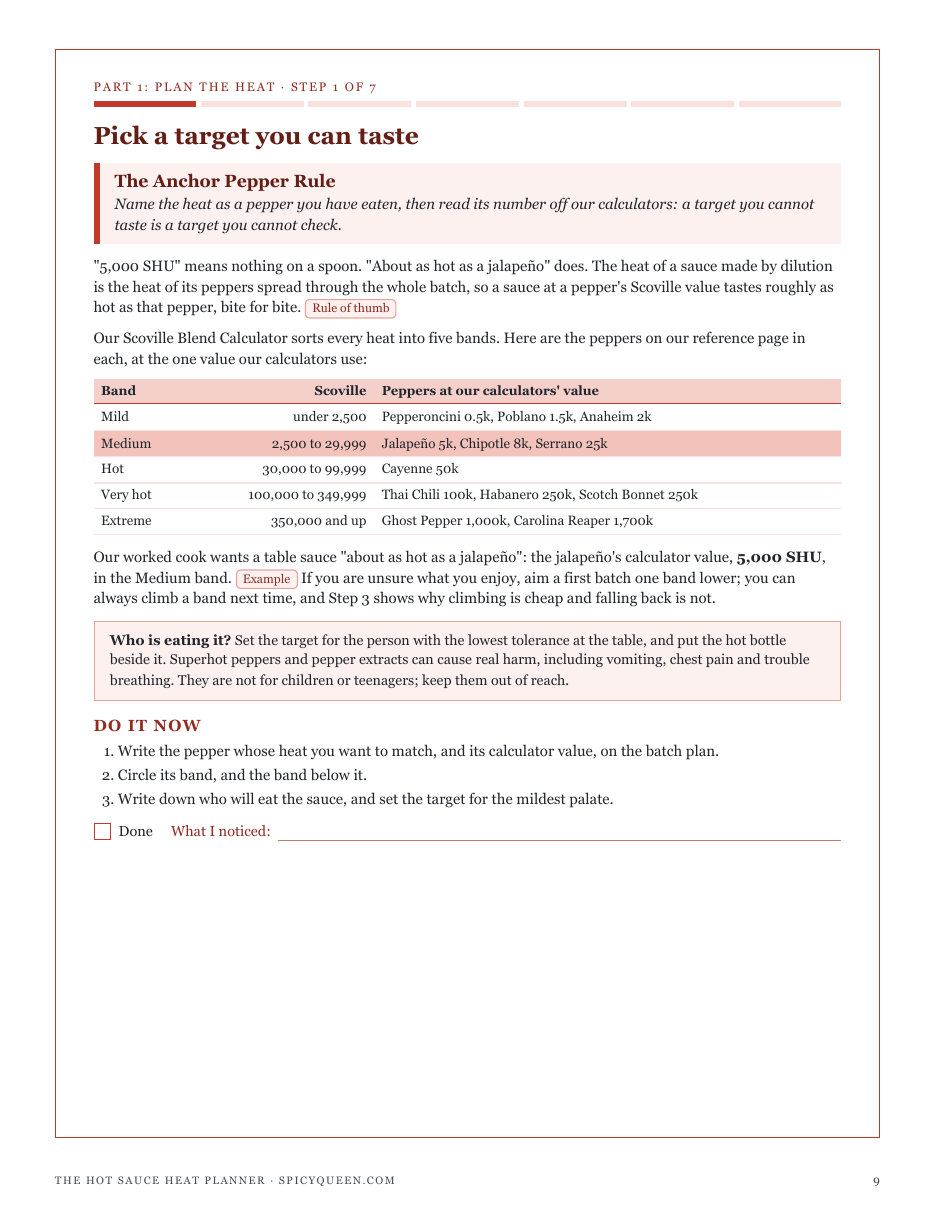
Two full pages from the planner, exactly as printed. Click either to read it at full size before you decide.
What is in it
- The Anchor Pepper Rule: name the heat as a pepper you have eaten, with the five heat bands and the peppers in each
- The Range Rule: every pepper's low, calculator and high Scoville values, and where the calculators' number sits
- The Start-Low Rule: the start, calculator and ceiling weights, and a four-step additions ladder with the heat after each
- The Flavor-Then-Fire Rule: set the mild pepper first, count its heat, then solve for the hot one
- The Match-the-Heat Rule: swaps bracketed across the substitute's range, and the weight check that flags a poor match
- The Add-Base-Not-Hope Rule: the base that rescues a batch that ran hot, and why starting low is cheaper
- The Same-Ratio Rule: scaling by weight instead of counting pods, and the price of one bottle
- Three working pages: a batch plan and additions log, a swap and blend worksheet, and a scale and cost sheet
- A reference table of grams per 1,000 g for four targets and every pepper, the formulas on one card, and a quickstart
- A personalised sheet worked from the figures you enter in the heat-scaling, dilution, substitution and blend calculators
- ✓ 23 printable pages
- ✓ 10 sections, worksheets and templates
- ✓ A second PDF worked out from the numbers you enter
- ✓ No account needed, just an email address
- ✓ Instant download; link valid 7 days
Price includes any taxes. Sold by GrabURL, who handle checkout and support. The charge appears on your statement as GrabURL.
The planner picks up where the free Hot Sauce Heat-Scaling Calculator leaves off. The calculator gives one pepper weight from one Scoville number per pepper; the Pepper Reference lists the range that number sits in, and the planner turns every answer into a bracket you add in measured steps. It uses the Scoville Blend Calculator to check a mix and the Chili Substitution Calculator to swap at equal heat. It is about heat and weight only: it does not cover making a sauce shelf-stable or how long to keep it. Keep homemade sauce in the refrigerator unless you follow a tested shelf-stable recipe exactly.